RAISED GARDEN BED
A bed sized to your yard and your reach. Set the size below and get every board and screw on one list.
Pick a shape and a size. The boards and the screws change automatically.
CAN I BUILD THIS?
3 steps, all square cuts. One afternoon.
SHOP
9 MATERIALS TO GET · 7 TOOLS TO GET
Drawn end-on. ClickTap anything you already have.
CUT LIST
7 BOARDS · 2 SIZES TO CUT
LABEL EACH PIECE
ClickTap a piece when it’s cut, clicktap again to undo.
2×6×8′ BOARDS
0 OF 4 CUT4×4×8′ BOARDS
0 OF 4 CUT- A: Corner block
BUILD STEPS
3 STEPS
- OPTIONAL GLUE
Every screw lands on a block’s centerline, so nothing splits.
ABOUT THIS PLAN
Measure the spot in the yard first. The plan starts with your footprint: a straight run, an L around a corner, or a U you stand inside, any length from 3 to 12 feet, 2 to 4 feet across, two to four boards tall.
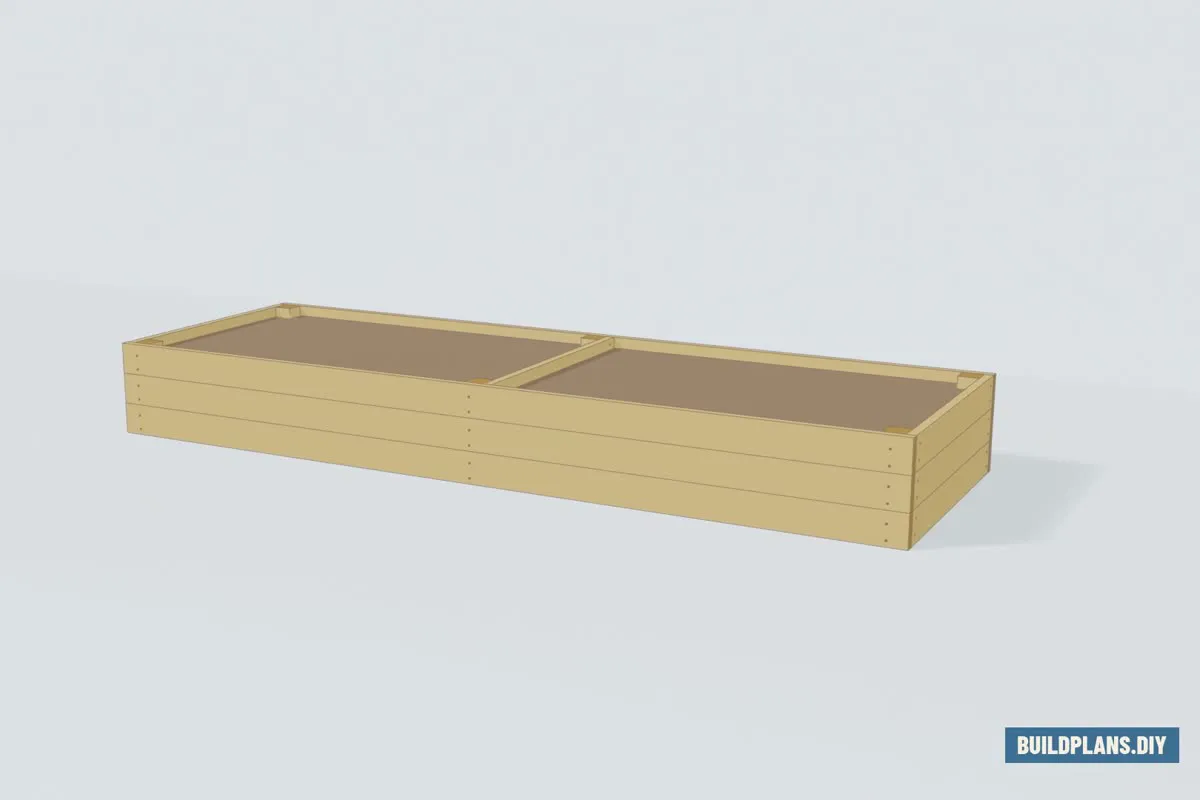
It’s stacked 2×6 boards with a 4×4 block inside each corner, full height, and both walls screw into it: two 3 1/8″ exterior screws per board, one screw length for the whole bed. The long boards run through the corners, so their ends hide the end boards’ end grain and the corner you see is one clean face. A wall past 96″ at this height gets a cross brace at the middle; yours doesn’t need one. It’s built on a flat surface and carried to the spot, with no post holes, and it fills to 2″ below the rim.
COMMON QUESTIONS
Is pressure-treated wood safe next to vegetables?
The treated lumber sold today is copper-based (the arsenic kind left the shelves in 2004), and university extension offices have looked at exactly this question. Oregon State grew vegetables three seasons in copper-treated boxes and found no copper increase in the food; Maryland Extension’s finding is that the copper that does leach stays in the soil touching the wood. That is why this plan is built from ground-contact pressure-treated lumber. It lasts 15 to 20 years in dirt. If you’d rather not have it near food, buy the same boards in cedar: same cuts, same screws, a different shopping list.
Why a 4×4 in each corner instead of metal brackets?
Because the block gives both walls 3½″ of wood to screw into, every screw lands 1¾″ from a board end where nothing splits, and one screw length does the whole bed. One 8-foot 4×4 cuts all four corners of a two-board bed with wood to spare. A set of corner brackets is one board tall, so a two-board bed needs two sets, and they cost more than every 4×4 on this list put together.
Will the long sides bow out?
Damp soil pushes hard, and a long 2×6 wall bends at the middle. The field rule is that beds past 8 feet bow. This plan checks every wall against a limit that tightens as the bed gets taller (96″ at 2 boards), and any span over it gets a cross brace: a 4×4 block on the inside of each long wall and a 2×4 between them, flush with the top, so nothing sticks up above the rim. Your bed is inside the limit and builds without one.
Does it need a bottom?
No. It sits on the ground, open, so roots go down and water drains. People put all sorts of things under a bed: hardware cloth where gophers or voles dig, cardboard or a weed barrier to smother the grass. Whatever you use, lay it down first, or tip the bed on its side and fix it across the bottom edges before the bed is placed. A one-board-tall bed is really a border for the native soil under it; two boards and up is where the fill is deep enough to plant into on its own.
My yard slopes. What then?
Build it flat on the driveway, carry it over, and dig the high side in until the level reads true both ways. The corner blocks stop at the bottom of the boards, so there are no posts to sink. On a real hillside, build two shorter beds stepped down the slope instead of one long one dug deep at one end.
Can I make it an L or a U?
Yes. It’s the first switch on the page. An L wraps a corner; a U is a bed you stand inside with soil on three sides. The same width runs every leg, the leg has to reach at least a foot past the width (or it isn’t a leg), and a U keeps 2 feet clear between its legs. That’s where you stand. The inside corner gets its 4×4 block on the outside, in the notch, screwed from inside the bed before any soil goes in.
Why is a 2×6 not actually 2 inches by 6 inches?
The name is the size before the mill dries and planes it. Every board sold as a 2×6 really measures 1 1/2″ × 5 1/2″, which is why two of them stacked make the 11″ bed you see everywhere and four make 22″. Every height, every end-board length and every block on this page is already worked out from the real size. Cut to the numbers as written and the corners come out flush.
Can I build it from cedar instead?
Yes. Every cut and every screw is the same; buy the 2×6s and 4×4s in cedar instead of treated. Treated ground-contact lumber lasts 15 to 20 years or more in dirt and costs the least, which is why the shopping list is priced in it; cedar lasts 10 to 15, looks better, and costs more. Western juniper is one of the best options at 30 to 50 years with ground contact. Whichever you pick, the screws are the same 3 1/8″ exterior wood screws, the one part that must not rust away inside a wet corner.